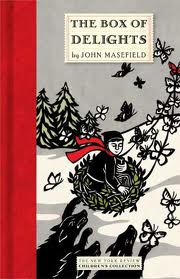
One of C.S. Lewis's Favorites: The Box of Delights


    Of The Box of Delights, C.S. Lewis said, that it is a unique work and will often be re-read…the beauties, all the 'delights' that keep on emerging from the box—are so exquisite, and quite unlike anything I have seen elsewhere. Those of us who re-read the writings of Lewis would recognize some clear references and allusions to The Box of Delights, especially in Lewis's own The Magician's Nephew
     The Box of Delights was first published in 1935, and was acclaimed and embraced on a popular level. Some place it on the same level of excellence and as perfect for the Christmas season as Charles Dicken's A Christmas Carol. The plot is simple in that it focuses on the adventures of Kay Harker and a gentleman Cole Hawlings who has a magical box that is most desired by a group of criminals. As you assemble your Christmas season reading list, or gifts for children who are burned out on the most recent dystopian series, this is a delightful read that will be enjoyed by those, young or old, open for an enchanting read.

Popular posts from this blog

Faith, Hope, and Love in a Culture of Death: Lois Lowry's The Giver as Film

Let's begin with the film's single greatest obstacle: the culture Philip Rieff described as "the death culture" is not likely to assemble en masse to pay for viewing a morality tale. A central message in this film is that we have become "shadows." Indeed, those immersed in our death culture do not likely have ears to hear and eyes to see the hollow selves we currently are. In a time such as ours, where very little if anything signifies, it is not probable this movie will be understood. At one key moment The Giver declares, "we are living a life of shadows, of echoes." This sentence captures the essence of the death culture. Add to that the following minor problem of our nearly national obsession with spectacle, as evidenced in news shows and recent popular YA movies such as The Hunger Games and Divergent . It is clear our current death culture is taken with the dystopian novel and dystopian movie version of said novel as long as it provides ...

How Twitter Killed Tolstoy or Why You Will Likely Not Finish this Blog

     My favorite fictional Professor, aptly described the end of learning. Faber, tells how his class went from Sven Birkerts The Gutenberg Elegies: The Fate of Reading in an Electronic Age The Pleasures of Reading in an Age of Distraction Alan Jacobs Slow Reading in a Hurried Age David Mikics Words Onscreen: The Fate of Reading in a Digital Age Naimi S. Baron My own experience parallels that of Professor Faber. With declining Liberal Arts majors and distracted Great Books students.... Our lives have become as thin as the thinnest flat screen TV. There is a hollowness to our public discourses and our private conversations. It is not surprising how the tone, texture, and content of our verbal exchanges mimic posts on our dominate social media or the headline stories Of course, the title of this blog could have been any of the following: How Instagram Killed How Vine Killed How Facebook Killed How Google+ Killed How LinkedIn Killed

If Dostoevsky Had Written Science Fiction

    Sounding like a modern, the Greek writer Callimachus once penned an epigram where he quipped, “a large book is a great misfortune.” Does not the legitimacy of such an assertion depend on the author and the reader? Novelist Michael O’Brien gives all lovers of fine novels another marvelously large book. As one who enjoys good science fiction, it is always a treat when a first rate novelist ventures into a genre different than what is the norm for that novelist.     Often when talking about literature, someone will ask, “what is it about?” This question is sometimes confused with the more important question of, “what are the possible meanings of this work?” While the storyline of Voyage to Alpha Centauri  is about a trip of the spaceship Kosmos to Alpha Centauri and given to us primarily in the form of the diary of Neil de Hoyos, one might be able to say that the novel  is really about what it means to be a human being, the human...